How to prepare for a portrait or brand shoot
Photography6 min read
Plan four looks and roughly one hour per look, choose clothes that skim rather than cling or swamp, and avoid fine stripes and tight repeating patterns — they distort on a digital sensor. Bring a shot list written from the posts you actually make. Add vertical video if social is where the work goes: 9:16 clips carry roughly 5% engagement against 3.4% for square or horizontal.
Most people book a content shoot, turn up with one outfit and a vague hope, and leave with fifteen versions of the same photograph. Then they are back three months later because the feed has eaten them all. The difference between that and a shoot that carries a business through a quarter is entirely planning, and almost none of it is technical.
Start from what you post, not from what looks nice
Before anything else, open your own feed, your website and your last five newsletters, and write down the kinds of image you keep needing. Almost every small brand needs the same six:
- One clean portrait on a plain background — for press, profiles, speaker bios, podcast cards.
- Working shots — you doing the actual thing, hands included, from more than one angle.
- Environmental frames with space around you, so text can be laid over them for banners and ads.
- Detail shots — tools, products, packaging, a desk. These carry captions when you have nothing to show.
- Something human — laughing, mid-sentence, not looking at the lens. These consistently outperform the polished ones.
- Vertical frames, shot vertically, not cropped from a horizontal afterwards.
That list is the shot list. It takes fifteen minutes to write and it is the single highest-leverage thing you can do before a shoot.
Four looks, and how to choose them
Four is the number that works: enough range that the gallery does not look like one afternoon, few enough that you are not spending the session getting changed. Budget roughly an hour per look including the change.
| Look | Purpose | Typical choice |
|---|---|---|
| 1. Polished | Press, profiles, the website header | Tailoring, one strong colour |
| 2. Working | In-context shots, process content | What you genuinely wear to work |
| 3. Relaxed | Stories, reels, the human posts | Knitwear, denim, softer shapes |
| 4. Signature | The one that is unmistakably you | Your colour, your silhouette |
The instinct to make all four look expensive is the one to resist. A gallery where every frame is a founder in a blazer is a gallery you will get bored of posting by week three.
What photographs badly
Four things, and the last one is genuinely technical rather than aesthetic. There is a fuller treatment of colour, fabric and fit in what to wear for a photoshoot.
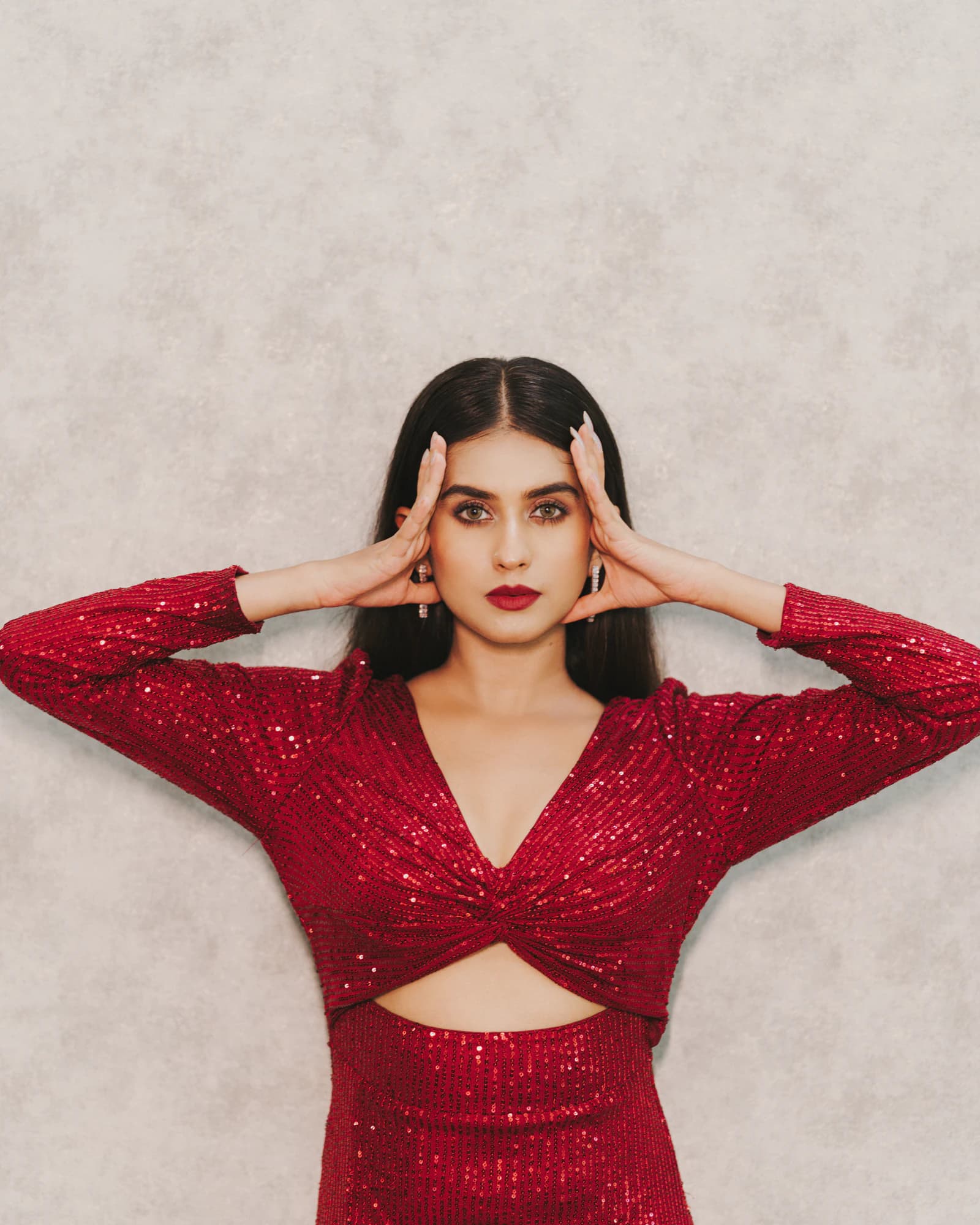
- Oversized clothing reads as boxy. Volume that looks architectural in a mirror looks shapeless flattened into two dimensions.
- Very tight clothing shows every line, seam and fastening the camera can find.
- Busy florals and high-contrast prints pull the eye off your face, which is the one thing the photograph is for.
- Fine stripes, herringbone and tightly ribbed knits can produce moiré — a shimmering rainbow interference pattern created when a tight repeating weave collides with the sensor's own pixel grid. It is not a lighting problem and it is largely unfixable afterwards. This is the one rule worth following even if you ignore the rest.
What does photograph well: clothes that skim the body, natural fabrics with some weight to them, and colour that agrees with your brand palette rather than fighting it. If your site is warm and cream, arriving in cold grey produces images you will find oddly hard to use and never quite work out why.
Hair and makeup for a content shoot
This is where a photography-only booking quietly loses. A camera flattens dimension, so an everyday face that looks perfectly good in the mirror photographs washed out — and once it is in the file, it is a retouching job rather than a fix. Makeup for a shoot is built a step stronger than makeup for a room, for exactly the reasons set out in why makeup for photography is different.
It also solves the practical problem: if your looks change four times, someone needs to adjust hair between them. Doing that yourself in a bathroom mirror is how a three-hour shoot becomes a four-hour shoot.
Add vertical video, and shoot it vertically
If any of this is going to Instagram or TikTok, vertical is not a crop — it is a different set-up, and the numbers justify treating it as one.
| Format | Engagement rate |
|---|---|
| Vertical 9:16 video | ~5.0% |
| Horizontal or square video | ~3.4% |
| Carousel | ~0.99% |
| Single photo | ~0.70% |
Reels average around 16,153 views against roughly 198 for a standard photo post, and the algorithm gives 9:16 material materially more reach than square or horizontal. Accounts under 50,000 followers are the ones with most to gain, and posting reels consistently is associated with roughly 25% faster follower growth.
The practical consequence: budget an extra hour and shoot the vertical material as its own pass, rather than hoping a 3:2 frame will survive being cut down to 9:16. It will not — the composition that makes a horizontal portrait work is precisely what gets cropped away.
On the day
- Eat first. Three hours of being photographed is more tiring than it sounds.
- Arrive in look one, ready, with the other three on hangers in order.
- Bring the props that are actually yours. Your notebook, your product, your tools. Borrowed staging reads as borrowed.
- Do the clean portraits first, while you are freshest and least self-conscious about the camera.
- Keep the last twenty minutes loose. The frames people end up using most are almost always from the point in the session where everyone stopped trying.
And plan what happens afterwards. A gallery of forty images that sits in a folder is worth nothing; the same forty scheduled across a quarter is worth the whole fee. Decide the posting plan before the shoot, not after — it also tells you, honestly, whether you need forty images or fifteen.
Recent work is in the portfolio, and pricing for one-, two- and three-hour sessions is on the services page.
Common questions
How many photos should I expect from a brand shoot?
Roughly 12–15 edited images from an hour, 25–30 from two hours and 35–40 from three. More than that is usually a sign of near-duplicates padding a gallery rather than genuine range.
How many outfits should I bring to a photoshoot?
Four planned looks, plus one spare you would be happy to wear. Budget about an hour per look including the change, which is why a four-look shoot is a three-hour booking rather than a one-hour one.
Should I get professional hair and makeup for a brand shoot?
For anything going on a website or into press, yes. A camera flattens features, so an everyday face photographs weaker than it looks in person — and that is a correction far cheaper to make at the shoot than in editing.
Can you shoot vertical video and photographs in the same session?
Yes, and it is the efficient way to do it — same looks, same location, same hair and makeup. Allow an extra hour for the video pass, because vertical needs its own framing rather than a crop from a horizontal frame.
Sources
- Instagram Reels Statistics 2026: Key Stats and What They Mean for Growth — Loopex Digital
- 100+ Instagram Reels Statistics for 2026 — Zebracat
- What to wear for your personal branding photoshoot — Kate & Co.